Reflections on Ahmad Tallaa: The Living Archive
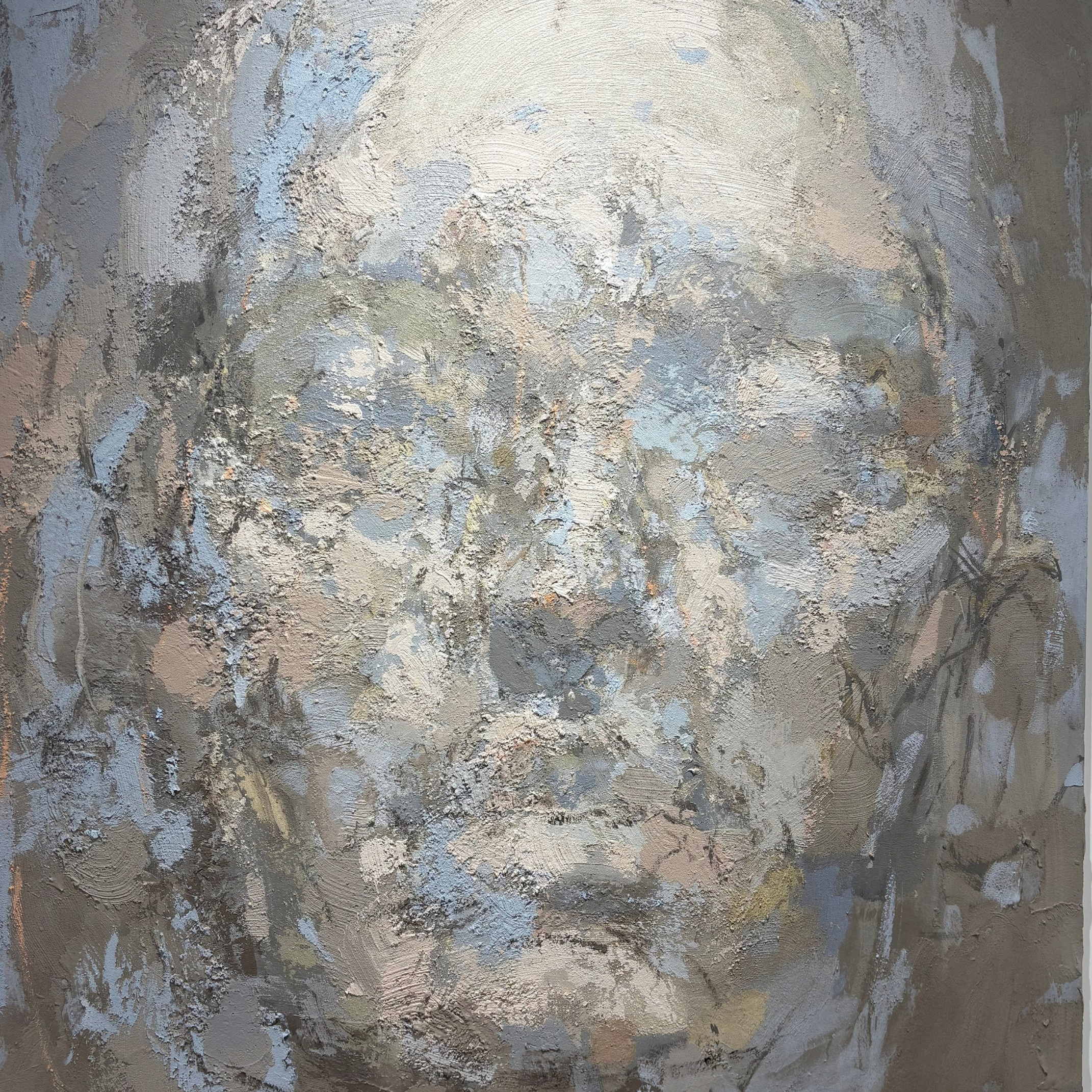
Ahmad Tallaa's The Living Archive, curated by Céline Azem, runs from the 21st September to the 11th November 2026 at Firetti Contemporary, Dubai.
Amongst the creative bustle of Alserkal Avenue, Tallaa’s philosophical work sits quietly within Firetti Contemporary’s restrained gallery space. Tallaa’s ‘The Living Archive’ is underpinned by a concept outlined immediately as you step into the space:
‘The body remembers what language cannot hold. Memory lives in the way a person carries themselves, in the lines that deepen across a face, and in the traces that remain long after the circumstances that shaped them have passed.’
Tallaa’s work embodies the philosophical concept of ‘what we go through shapes us’, leaving an imprint on us that we, without realising, carry throughout the rest of our lives.
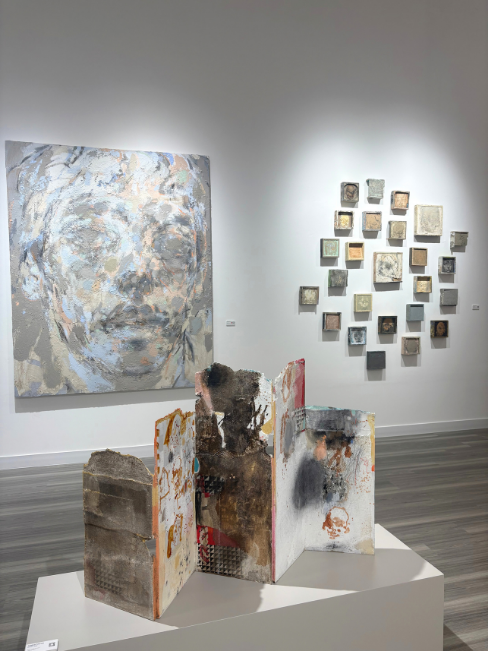
The works were installed throughout the gallery, with most pieces wall-mounted, while a smaller number of sculptural works were presented on podiums within the gallery space. This display format continues as you journey up the stairs and onto the mezzanine above.
From first glance, most works resemble a similar composition; troubled facial structures, an evocation of imprint, and in some cases, an almost Pointillist use of paint.
There is also an evident wider exploration of fragmentation - pieces of a bigger picture, expressed in different ways - be it through sculpture, portraits, artist books or small recycled wood panels mounted to the wall.
Primarily the portraits are what catch my attention, and what I end up spending the most time over. Although one could argue that they are pretty emotionless faces, I still read a sense of mild discomfort and uneasiness. ‘Untitled’ (2026), shown on the right, depicts facial features that seem marked and partially obscured. The colours, muted taupe, beige and greys, suggest age and feel almost ‘lived-in’, rather than fresh and youthful.
The larger scale portraits also play with a muted colour palette, consisting of greys, blues, beiges and creams, with subtle accents of peach and chocolate brown. These works appear somewhat less ‘aged’ than the line drawings but still retain the ‘imprinted’ or ‘marked’ quality, but not so aggressively.
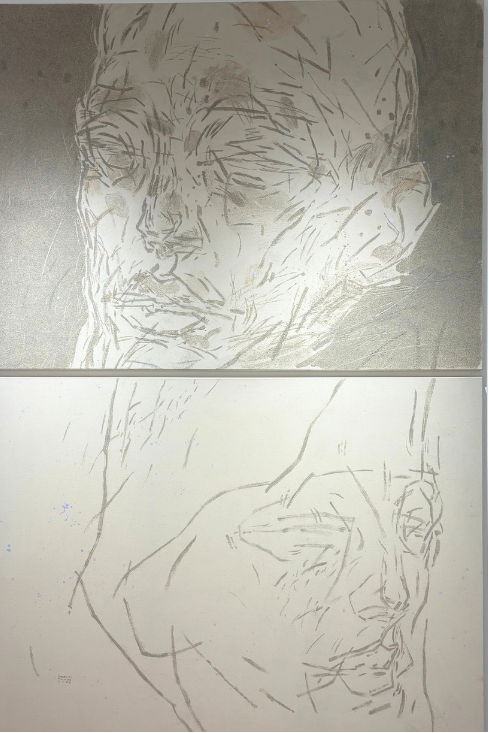
Drawing attention to the framed extracts of the artist’s sketchbook, it is clear the sense of imperfection that is retained here. The compositions of the pieces are similar, and suggest a study worked in fragments. It is noticeable the rugged edges of the parchment and the abstract use of paint and ink throughout the work. Tallaa has intentionally fed through the feeling of his sketchbook with handwritten annotations in Arabic on the glass of the frame itself. The work feels human, experimental and intentional.
‘Nothing here remains entirely fixed. Marks fade without disappearing completely. What is carried forward bears the trace of what came before, but never precisely the same form.’
The two compositions of mounted recycled wooden pallets offer similar expressions of imperfection, fragmentation and pieces collected and curated without much sense of cohesion. Both works feel intimate and collected with intention, almost as though they weren’t intended for public viewing - offering a deeper insight to the inner world of Tallaa.
Between these mounted works lay a few sculptural pieces varying from stone (or possibly marble) to erected folded artist pages depicting miniature portraits with crossed out parts and abstract colour-work, torn at the top at different levels of height from one side to the other. The Arabic annotations continue throughout this work, much like the framed sketchbook pages.
‘We are shaped by what we have lived through, but we are not its final form.’
Material carries its own history
Tallaa chooses recycled materials consistently throughout his work, with the justification that they retain signs from their previous lives, even when transformed into something else. This idea is continuously explored through the artist’s choice in medium, such as the sand collected from the beaches of the UAE, which he uses in his work as a locational and meaningful tie to his philosophical viewpoints.
It seems Tallaa’s recycled materials are merely limited to the Arabian sand he collects, but actually spans through his own repurposed work, collected artefacts and natural materials, all of which once had an original purpose and have been crafted into taking on new roles.
The face as the archive
The same principle seems to operate for the portraits themselves. The faces have a clearly manipulated texture, layered in a paste-like paint, yet the physical features never fully disappear. What the viewer gains from the portrait seems to become less about what the figure looks like and more about what they may be carrying.
The exploration of this concept expands the exhibition beyond the human body and tangible materials, towards the idea that lived experience can leave traces that exceed what we are able to narrate or consciously remember. In this sense, the work brought to mind ideas explored in Bessel van der Kolk’s The Body Keeps the Score. Tallaa approaches this visually through material and surface: his portraits are layered, carved, built and scratched, as though the materials themselves carry a history.
Throughout this exhibition the core concept of ‘The Living Archive’ is not only expressed through the human experience, but through the lives of inanimate objects - enduring, transforming and becoming something entirely changed, yet still holding on remnants of what it has always been.
We are shaped by what we have lived through, but we are not its final form.
‘We are, in this sense, living archives.’